
Hardin County’s Multi-Day Arrest Reports
The News-Enterprise jail log is the paper's recurring blotter. Each edition says it comes from Hardin County Detention Center bookings. Editions follow publication windows rather than a fixed rolling period. Sample runs covered Sunday to Monday and Monday to Tuesday. Others covered Thursday to Friday. One span covered a Friday-to-Monday weekend. Each window closes at a 3:00 p.m. cutoff set by the editor, not by the detention center.
That difference matters. A newspaper compiles a text snapshot once booking information exists. An arrest can miss one edition's cutoff. It may surface later. Someone listed may already be released by the time you read the item. The publisher is not the records custodian. It never sets custody status at HCDC.
Bookings in the countywide log may come from HCSO, HCDC, Elizabethtown Police, Radcliff Police, Vine Grove Police, Kentucky State Police, or another agency. Treat an agency label carefully. It may show who arrested, transported, or held the person. Or it may simply show how the publisher sorted the entry. The residence listed is not proof of where the incident happened either.
Read Hardin Arrest Reports in Order
Work backward by publication date, and note each article's stated start and cutoff. The headline date rarely equals the booking date.
- Open The News-Enterprise local section and locate the newest Hardin County jail-log item.
- Read the date range and 3:00 p.m. language in the article or reproduction.
- Compare the person’s name, age, residence area, and charge text; a name alone is weak identification.
- Check the prior edition if the likely booking occurred near a cutoff, weekend, or holiday.
- For today’s unresolved event, switch to Arrested Today and contact HCDC.
- For the underlying official intake record or photo, submit a specific request to HCSO/HCDC rather than asking the newspaper to certify custody.
The captured News-Enterprise local section shows the publication environment where recurring county coverage appears.
Treat the section as an archive entry point, then confirm details with the responsible office.
Fields in Hardin Arrest Reports
The jail-log pages carry only a narrow set of fields. Skip the richer columns unofficial booking sites display.
| Published item | What it can and cannot establish |
|---|---|
| Name | Identifies the listed booking subject but still requires identity checks. |
| Age | Helps separate similar names; it is not a complete identifier. |
| Residence area | Describes the area printed by the newspaper, not necessarily the arrest location. |
| Charges | Reflects booking charges at compilation time, not a conviction or final case caption. |
| Window | Shows the edition’s stated period and cutoff, not current custody. |
| Photograph | No booking-photo gallery was verified in sampled text logs. |
Ask the record custodian for booking time, arresting agency, bond, booking number, or a photograph. The intake file may hold them, but the newspaper does not guarantee those fields. The known jail-log article shows the format in practice.
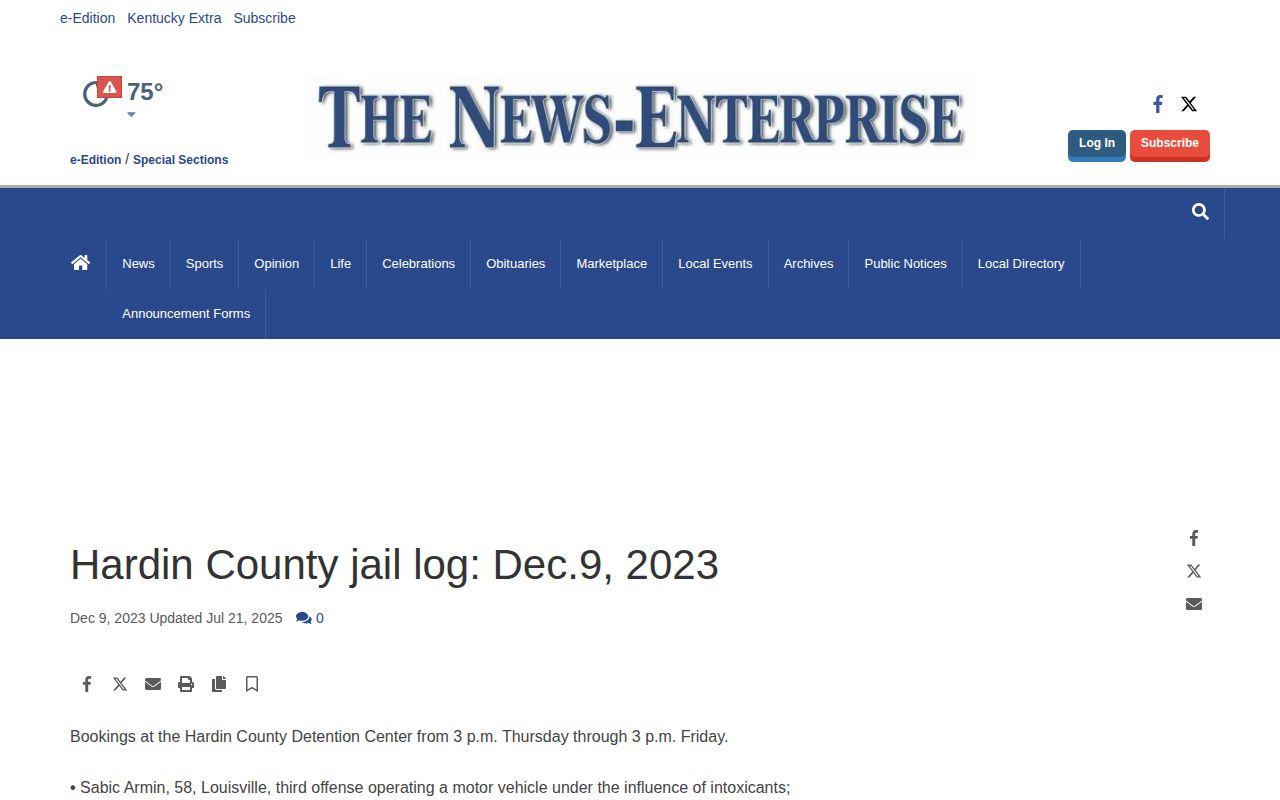
In short, the newspaper logs one defined booking period; it is not a live jail roster.
Weekend Hardin Arrest Cutoffs
A Friday-to-Monday edition shows why multi-day reporting beats a same-day search. The wide window gathers bookings across days when publication pauses. It still proves no fixed weekend surge count. HCDC posts no official weekend schedule or public feed. A Sunday arrest might land in a Monday cutoff. It could also appear in a later publication, or nowhere at all. Check adjacent editions around the expected arrest date. When custody or safety information is urgent, do not wait for print. Call HCDC and register with Kentucky VINE.
Local crime stories on K105 can add incident context. The station keeps no dedicated Hardin jail log. The unofficial RecentlyBooked Hardin index offers another date lead. Its update claim, fields, and custody labels are not HCDC records. News coverage and secondary indexes run incomplete or stale. Neither substitutes for direct custody confirmation.
Hardin Arrest Archives and Retention
HCDC publishes no booking-record or photograph retention period. An article vanishing does not mean records were destroyed. An unofficial copy staying online does not mean the county still holds the file. Newspaper PDFs, search caches, and aggregator archives preserve things separately.
Requesting an older booking? Gather the full name, date, agency, and booking number if known. Also gather the exact record you want. Ask HCSO or HCDC which schedule or exemption applies if the material is no longer held. For older court cases, ask the Circuit Court Clerk. The clerk can say whether the file stayed local, moved to a records facility, or was disposed of under a Court of Justice schedule. KDLA's court-record guide maps deeper archive routes, though HCDC photographs do not simply transfer there. The historical Ada Icon log proves law-enforcement log material can survive outside current publication.

It is an archive example, not a current Hardin booking source or custody check.
What Hardin Arrest Reports Cannot Answer
A blotter cannot tell you whether someone is still confined, released, transferred, prosecuted, or convicted. Call HCDC for current local custody. Use VINE for covered status changes. Kentucky DOC's KOOL system covers state corrections. Federal and immigration cases belong to BOP and ICE systems.
For arraignment, bond orders, pleas, dismissals, diversion, trial results, or sentencing, follow the charge through CourtNet. You can also take it to the Circuit Court Clerk. Charges printed at booking can change as a case moves. A missing follow-up article says nothing about how things ended.
Request a Hardin Booking Record
The newspaper log points you toward a Hardin County record. It is no substitute for the official file. Start with HCDC or HCSO and ask which office serves as custodian. If city police made the arrest, that department may keep the incident report. The jail holds the booking material. Naming the exact document keeps you from merging separate files into one unreliable profile.
Give the full name, booking date, agency, and booking number. Details you might receive include the arrest time, the charge entry, and bond. You may also receive a booking photo if one exists and can be released. Kentucky law lets agencies redact or withhold material. Juvenile protections, sealed matters, privacy interests, and investigative limits all play a part.
HCSO sits at 150 North Provident Way, Suite 101. Call 270-765-5133 on weekdays between 8:00 a.m. and 4:30 p.m. HCDC is at 100 Lawson Boulevard. Confirm which office holds what. Never assume the sheriff keeps everything from the detention center. HCSO publishes no booking-photo policy or fee schedule. Ask the office whether a photo exists and what it costs.
Route Older Hardin Arrest Records
Older Hardin County arrest records take a different route. The HCSO request page links the Kentucky Attorney General's standardized open-records form. It also posts request email addresses. Check those contacts before you send any identifiers. Material may be withheld or no longer held. The custodian must name the exemption or retention schedule that applies. The county's five-working-day policy is a response framework. It does not prove an HCDC-specific retention term.
Court archives work differently. A file may stay with the clerk. It may move to a records facility or be destroyed under an authorized schedule, per the Kentucky Court of Justice. The clerk can supply a locator for transferred files. KDLA guidance helps with older court materials. It does not show that jail photographs went to the state archive.
Keep three request types separate. A newspaper archive request covers the article or the reproduced jail log. An HCDC or HCSO request covers the underlying booking material the government holds. A clerk request covers the court case and its disposition. Give each custodian the likely date, full name, agency, and record type. A surviving newspaper PDF proves only that the published snapshot was preserved. It says nothing about current custody or county retention of a photograph.
Some material stays closed. Juvenile, sealed, expunged, investigative, and private records may face extra review. Some may see no release at all. A custodian can cite the lawful basis for any redaction. Empty archive results never prove an arrest failed to occur.
Public Record Search
Sponsored Results